

Reach-in Freezer Maintenance: The 2026 Essential Checklist for Austin Businesses

Updated: Sep 30
Could a single neglected condenser coil be the silent drain on your Austin business's profitability this year? With trade tariffs driving up the cost of replacement parts and new 2026 refrigerant regulations shifting the industry toward A2L systems, the stakes for your cooling equipment have never been higher. You already know that a mechanical failure in the Central Texas heat is a recipe for disaster. Consistent reach-in freezer maintenance is no longer just a chore on a list; it's your primary defense against spiking energy bills and the threat of health department violations.
We understand the pressure of maintaining a high-performance kitchen while managing the rising costs of the 2026 economic landscape. We're here to help you navigate these challenges with a professional-grade maintenance framework designed to keep your systems running at peak efficiency. By following this essential checklist, you'll protect your valuable inventory, eliminate food spoilage incidents, and extend the lifespan of your hardware. This guide explores technical optimization strategies and highlights how local incentives, like Austin Energy's $550 per kW rebate for high-efficiency motors, can turn your routine care into a significant financial advantage.
Key Takeaways
Learn why proactive reach-in freezer maintenance serves as a vital financial hedge against 2026 trade tariffs and unpredictable energy price spikes.
Follow a simplified daily and weekly checklist to stop air leaks and ice accumulation before they cause equipment failure.
Use the "Dollar Bill Test" and other field-tested methods to protect your system from Austin's intense humidity levels.
Explore how professional Preventative Maintenance Agreements can stabilize your monthly budget and prevent thousands in lost inventory.
Table of Contents
The 2026 Economic Reality: Why Reach-in Freezer Maintenance Matters Now
Operating a commercial kitchen in Austin has always required a sharp eye on overhead, but 2026 has introduced unique financial hurdles. Between trade tariffs on imported steel and the rising cost of complex electronics, the price of a new commercial unit has climbed significantly. We view reach-in freezer maintenance as a fiscal protection strategy for commercial assets that ensures operational continuity while shielding your bottom line from these volatile market shifts. By investing in small, consistent actions, you create a "maintenance hedge" that helps prevent emergency repair bills that can easily exceed $5,000 when a system fails during a peak service window.
Local energy dynamics also play a role in your daily profitability. While Austin Energy commercial rates average around 6.81¢/kWh, the sheer volume of power required to fight Central Texas heat means that a poorly calibrated freezer is a constant drain on your monthly cash flow. Regular care, including cleaning coils and optimizing refrigerator efficiency and maintenance, ensures your hardware doesn't work harder than necessary to stay cold. This proactive approach transforms a simple chore into a powerful tool for resource management.
The 0°F Standard and Food Safety Economics
The USDA mandate for a 0°F storage temperature is a non-negotiable standard for liability protection. When your system experiences temperature drift, it doesn't just put your inventory at risk; it forces the compressor to run longer cycles. This increased wear accelerates mechanical fatigue and inflates your electricity consumption. Maintaining this precise thermal baseline is the most effective way to protect your customers and your equipment's longevity simultaneously.
Restoration vs. Replacement in a High-Tariff Market
In the current economic climate, purchasing a new freezer often means navigating supply chain delays and higher price tags due to national trade policies. Austral HVAC Refrigeration Services prioritizes a "restoration over replacement" philosophy, focusing on the high-quality components found in Daikin or Amana systems. Repairing a specialized part is almost always more cost-effective than a full replacement in 2026. This approach respects your financial health while ensuring your kitchen remains a high-performance environment without the need for unnecessary capital expenditures.
The Ultimate Reach-in Freezer Maintenance Checklist
Consistency is the cornerstone of equipment reliability. A well-executed reach-in freezer maintenance schedule prevents the gradual performance decay that leads to high energy bills and premature component failure. By breaking tasks down into manageable frequencies, your staff can catch minor issues before they escalate into kitchen-wide emergencies.
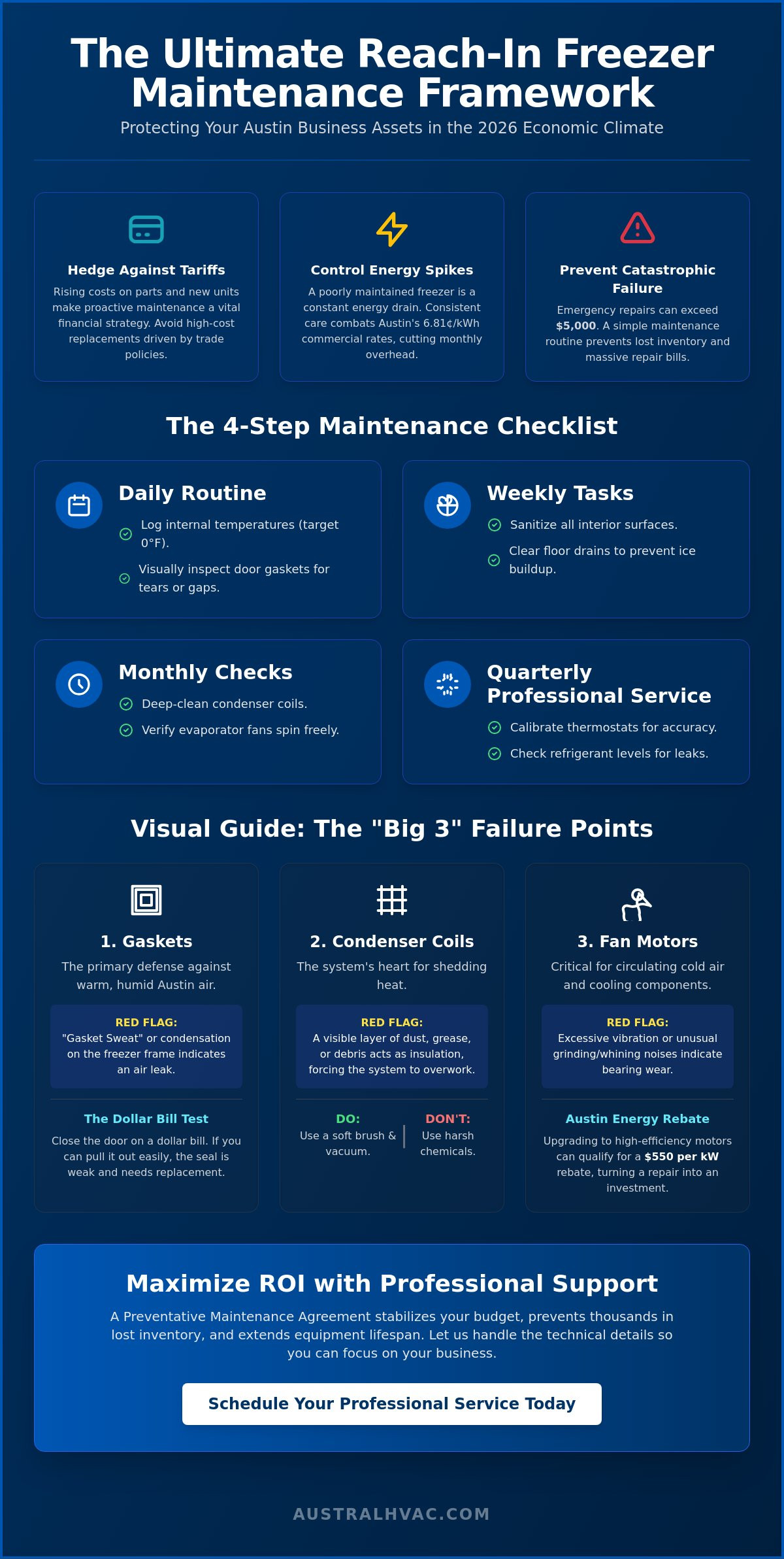
Daily: Log internal temperatures twice per shift to ensure you meet food safety standards of 0°F or lower. Visually inspect door gaskets for tears or air leaks.
Weekly: Sanitize all interior surfaces to prevent microbial growth. Clear floor drains of debris to avoid ice buildup that can damage the evaporator assembly.
Monthly: Deep-clean the condenser coils and verify that evaporator fans are spinning freely without excessive vibration or noise.
Quarterly: Schedule a professional calibration of thermostats and check refrigerant levels to ensure the system isn't leaking expensive, high-GWP gases.
Visual Guide: Identifying Wear and Tear
We recommend posting an infographic in your kitchen highlighting the "Big 3" failure points: gaskets, coils, and motors. Staff should be trained to spot "gasket sweat" or condensation on the exterior frame. This moisture is a red flag for air infiltration, which often precedes the need for a walk-in cooler compressor repair if left unaddressed. Catching these signs early keeps your restoration costs low and your kitchen running smoothly.
The Condenser Coil: The Heart of Efficiency
The condenser coil is responsible for shedding heat. In a busy Austin kitchen, grease and dust act as insulation, forcing the motor to work double time. To clean it, use a soft-bristle brush to loosen debris, then follow with a vacuum. Never use harsh chemicals on the coil; they can corrode the delicate aluminum fins and lead to permanent damage. If you're looking for a more hands-off approach, a structured Preventative Maintenance Agreement provides the specialized care needed to protect your hardware for the long haul.
Troubleshooting Performance Killers in the Austin Climate
Austin's humidity is a relentless opponent for commercial refrigeration. When moist air enters the cabinet during busy service hours, it condenses and freezes on the evaporator coils. This creates an insulating layer of ice that chokes off airflow and forces your system to run longer cycles to maintain temperature. Effective reach-in freezer maintenance in Central Texas requires a proactive approach to these local environmental stressors. You can perform a quick diagnostic using the "Dollar Bill Test." Close the freezer door on a dollar bill; if it pulls out with no resistance, your gasket has lost its airtight integrity, allowing humid air to infiltrate the system.
Watch out for "short cycling," a condition where the compressor turns on and off with excessive frequency. This isn't just a nuisance; it's an energy emergency that causes your electricity costs to skyrocket while placing immense strain on the motor. Short cycling often points to a dirty condenser or a failing pressure switch. If your equipment suffers a sudden failure that threatens your inventory, our case study on commercial refrigeration repair in Austin shows how a targeted restoration can protect both your stock and your budget.
Frost Buildup and Defrost Cycle Management
Most modern units feature automatic defrost cycles, but high-volume Austin kitchens often require manual intervention during peak summer months. If you find heavy frost on the coils, avoid using sharp objects to clear the ice. A single slip can puncture the evaporator tubing, leading to a costly refrigerant leak. Use a low-heat blower or a gentle steamer to safely melt the buildup without compromising the delicate aluminum fins.
Warning Signs That Require an Expert
Oily Residue: This is a classic indicator of a refrigerant leak that requires immediate attention from a technician.
Clicking Sounds: This usually points to a failing start relay or an electrical component under significant stress.
Rising Internal Temps: If the unit can't hold 0°F despite clean coils, the compressor may be losing its efficiency.
Ignoring a clicking sound today leads to a dead compressor tomorrow. Catching these mechanical hiccups early is the best way to respect your bottom line and ensure the longevity of your commercial assets. If you want to stop these problems before they start, we recommend exploring our Preventative Maintenance Agreements to keep your kitchen running at peak performance.
Professional Support: Maximizing ROI with Maintenance Agreements
While your internal staff can handle basic sanitation, technical reach-in freezer maintenance requires a specialized skill set to navigate the mechanical complexities of 2026 refrigeration standards. A Preventative Maintenance Agreement (PMA) isn't just a service contract; it's a strategic investment that stabilizes your operational budget. By shifting from reactive "break-fix" cycles to a planned schedule, you eliminate the financial shock of emergency call-outs. Our technicians perform granular inspections that go far deeper than a surface wipe-down, such as verifying refrigerant pressures, testing electrical connection integrity, and cleaning internal components without damaging sensitive sensors.
Professional oversight also ensures you are positioned to leverage local incentives that staff-level cleaning might overlook. For example, staying current with high-efficiency standards makes your business a prime candidate for the Austin Energy program, which offers rebates for upgrading to energy-saving commercial kitchen equipment. These incentives, combined with the reduced mechanical strain of a professionally tuned system, provide a dual benefit: lower monthly overhead and a buffer against the rising energy costs hitting Central Texas this year.
The Austral Advantage: Integrity in Every Service
Austral HVAC Refrigeration Services utilizes advanced diagnostic tools, such as ultrasonic leak detectors, to find microscopic issues before they empty your refrigerant tank. This proactive approach is essential in a market where supplies of older refrigerants are becoming scarcer and more expensive. Our team is committed to reliability and punctuality across the Austin metro area, treating every client with the personal care of a neighbor and the precision of an elite technical partner.
Building a Resilient Commercial Kitchen
A truly resilient facility looks at the big picture of food preservation. Integrating your freezer care with routine ice machine maintenance creates a holistic defense against equipment downtime across your entire line. We encourage you to view your HVAC/R provider as a high-performance partner rather than just another repair bill. Ready to secure your bottom line? Schedule your 2026 refrigeration audit with Austral HVAC Refrigeration Services today and ensure your kitchen stays cool, compliant, and profitable.
Secure Your Kitchen's Future in a Volatile Economy
Your refrigeration systems are the heartbeat of your Austin business. In an era defined by trade tariffs and shifting refrigerant mandates, consistent reach-in freezer maintenance has evolved from a simple chore into a vital financial safeguard. By focusing on restoration over replacement and mastering the unique humidity challenges of Central Texas, you ensure your equipment stays efficient and your inventory remains safe. You've seen how small adjustments to gaskets and coils can prevent massive capital expenditures while keeping your monthly energy bills manageable.
As an A+ rated local commercial refrigeration team and an authorized Daikin and LG Multi V specialist, Austral HVAC Refrigeration Services is dedicated to helping you navigate these transitions with integrity. We're also proud participants in the Austin Energy Rebate Program, ensuring you maximize every available incentive for your high-performance kitchen. Don't wait for a mechanical failure to disrupt your service. Protect your kitchen assets with an Austral HVAC Refrigeration Services Maintenance Plan and gain the mental ease that comes with professional, reliable oversight. We're ready to partner with you to keep your business thriving and your cooling systems running perfectly for years to come.
Frequently Asked Questions
How often should I clean the condenser coils on a reach-in freezer?
You should clean your condenser coils at least once every 90 days, though high-volume Austin kitchens often require monthly attention. Dust and grease act as insulation, forcing the compressor to work harder and increasing your risk of a breakdown. Regular cleaning is a core part of reach-in freezer maintenance that protects your equipment's longevity. By keeping these coils clear, you ensure the system sheds heat efficiently and remains reliable during the peak Texas summer.
What is the ideal temperature for a commercial reach-in freezer?
The ideal temperature for a commercial reach-in freezer is 0°F (-18°C) or lower to ensure food safety and quality. Maintaining this precise thermal baseline is non-negotiable for liability protection and inventory preservation. If your unit struggles to hold this temperature, it often indicates a failing gasket or a dirty condenser. Keeping the system at 0°F prevents bacterial growth and ensures you comply with local health department regulations while protecting your bottom line.
Why is my commercial freezer leaking water on the floor?
Water leaking on the floor usually points to a clogged drain line or a damaged door gasket. In Austin's humid climate, moisture can accumulate quickly. If the drain line is blocked by debris or ice, that water has nowhere to go but out the front of the unit. You should also check the gaskets for air leaks. If warm air enters the cabinet, it creates excessive condensation that overwhelms the drainage system and creates a slip hazard.
Can I use a hairdryer to melt ice buildup in my freezer?
We don't recommend using a standard hairdryer because the concentrated heat can warp plastic liners or damage sensitive evaporator components. Instead, use a specialized low-heat steamer or simply turn the unit off and allow it to defrost naturally. If you must speed up the process, a fan can help circulate room-temperature air. Taking a gentle approach prevents accidental punctures to the coils, which would lead to an expensive refrigerant leak and a major repair bill.
How much can I save on my electric bill with regular freezer maintenance?
Regular reach-in freezer maintenance can reduce your equipment's energy consumption by as much as 20% to 30%. When coils are clean and gaskets are airtight, the compressor runs shorter cycles to maintain 0°F. Given that Austin's commercial electricity rates average 6.81¢/kWh, these efficiency gains lead to measurable monthly savings. Investing in routine care is a proactive way to lower your overhead and protect your kitchen's profitability against rising utility costs.


Comments