

Daikin VRF Repair in Austin: The 2026 Guide to System Restoration

Updated: Sep 30
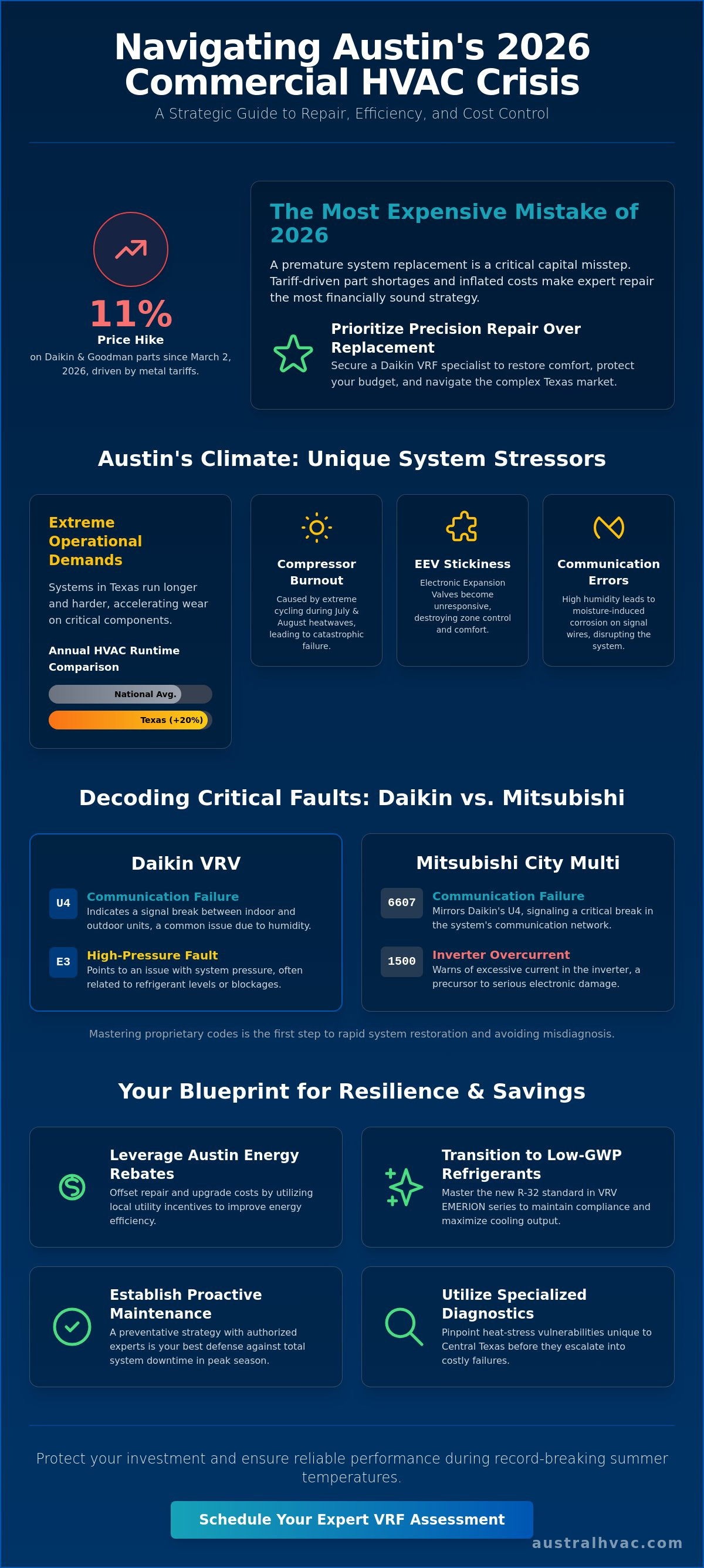
In 2026, the most expensive mistake an Austin business owner can make isn't a mechanical failure, but a premature system replacement. You've likely seen your operational costs climb after the March 2, 2026, price hike that pushed Daikin and Goodman part costs up by 11%. If you're currently facing a breakdown, securing a precision Daikin VRF repair Austin specialist is the most effective way to restore comfort without overextending your capital budget. We understand that your priority is keeping your doors open and your tenants comfortable despite the tariff-driven part shortages currently impacting the Texas market.
This guide empowers you to master the technical nuances of system restoration while managing the complex economic challenges of 2026 commercial HVAC. Mastering the transition to R-32 refrigerant in the new VRV EMERION series allows you to maintain regulatory compliance while maximizing cooling output. You'll also learn to distinguish between the specific maintenance requirements of Daikin and Mitsubishi systems to avoid common diagnostic errors. We'll detail how to utilize Austin Energy rebates to offset costs, ensuring your facility benefits from a service philosophy that favors your bottom line over a salesperson's quota.
Key Takeaways
Identify the distinct heat-stress failure points unique to Central Texas and learn how specialized diagnostic tools can pinpoint vulnerabilities before they lead to total system downtime.
Master the interpretation of proprietary fault codes, such as Daikin’s U4 or Mitsubishi’s 1500, to facilitate a faster restoration of your building's climate control.
Navigate the 2026 economic landscape of increased part costs due to metal tariffs by prioritizing a professional Daikin VRF repair Austin over expensive, unnecessary equipment replacements.
Leverage current Austin Energy rebates and the transition to low-GWP refrigerants like R-454B and R-32 to improve your facility’s energy efficiency and reduce long-term utility expenses.
Establish a preventative maintenance strategy that utilizes authorized manufacturer expertise to protect your investment and ensure reliable performance during record-breaking summer temperatures.
Table of Contents
Daikin VRF Repair in Austin: Understanding System Vulnerabilities
Daikin trademarked the term VRV, or Variable Refrigerant Volume, to distinguish its premier engineering from the rest of the market. While the names differ, both it and Variable Refrigerant Flow (VRF) technology describe the same elite multi-zone HVAC technology that redirects heat to maximize efficiency. In 2026, the Austin business community faces unique climate challenges that demand this level of specialized technical knowledge. Securing a professional Daikin VRF repair Austin ensures these vulnerabilities are addressed before they escalate into a full system shutdown. Our technicians perform precision sensor calibration to ensure your system reads ambient temperatures with absolute accuracy. This adjustment prevents the system from overworking, which significantly extends the lifespan of your expensive inverter components.
Common Failure Points in Austin Commercial Buildings
Austin's limestone foundations and high humidity create a harsh environment for sensitive electronics. Systems in Texas run approximately 20% longer than the national average, accelerating wear on mechanical parts. We frequently encounter these specific issues:
Compressor burnout: This is a frequent result of the extreme cycling required during July and August heatwaves.
Electronic Expansion Valve (EEV) stickiness: Valves can become unresponsive, which ruins zone control and leaves some rooms sweltering while others freeze.
Communication errors: High humidity often leads to moisture-induced corrosion on the signal wires between indoor and outdoor units.
Visualizing the VRF Cycle
(Editor's Note: Include a graphic here illustrating refrigerant flow between multiple indoor zones and a single outdoor unit.)
The true power of this technology lies in its ability to move heat from a server room that needs cooling into a perimeter office that requires warmth. This thermal redirection reduces the total load on the compressor, which protects your equipment from mechanical fatigue. By balancing the load across the entire building, the system maintains a steady state of comfort while drastically lowering energy consumption.
Mitsubishi VRF Repair and Daikin Troubleshooting: Your FAQ
"Is my system too proprietary for a local repair?" is the most common question we hear from Austin business owners. The answer is a firm no. While these systems are highly sophisticated, a specialized partner with the right diagnostic software can perform a successful Daikin VRF repair Austin without the corporate overhead of a factory representative. Precision diagnosis is especially vital in 2026, as Section 232 tariffs on imported copper and steel have significantly inflated the cost of replacement components. A Comparative Study on Energy Performance by the Lawrence Berkeley National Laboratory highlights how these systems outperform traditional setups, but that efficiency vanishes if the control logic isn't calibrated correctly.
Comparing fault codes is the first step in restoring your building's climate control. For Daikin, a "U4" signal indicates a communication break, while an "E3" points to high-pressure issues. Mitsubishi City Multi systems use different identifiers; a "1500" code usually warns of an overcurrent in the inverter, whereas "6607" mirrors the Daikin communication failure. If your facility utilizes a mixed fleet, you might also need LG Multi V Repair in Austin to ensure every zone remains operational.
Daikin VRV System Maintenance vs. Unplanned Repair
Preventative maintenance is your best defense against the dreaded "U4" error. Regular signal wire inspections prevent moisture from disrupting the data flow between units, which is a common issue in humid Texas environments. We also monitor oil recovery cycles during our visits. These automated processes return lubricant to the compressor, which prevents mechanical friction and protects your investment from the 11% part price increase seen in March 2026.
Mitsubishi City Multi Troubleshooting Tips
Mitsubishi VRF repair relies heavily on specialized M-NET diagnostic tools. These allow us to "see" inside the branch selector boxes where refrigerant leaks often hide in complex piping joints. Identifying a leak early prevents the system from running "lean," which protects the inverter board from overheating. If you're noticing uneven cooling across your office suites, scheduling a diagnostic check can save you thousands in avoided part replacements. Our technicians prioritize restoring these intricate components rather than defaulting to a total system sale.
The Economics of VRF in 2026: Tariffs, Parts, and Energy
Managing a commercial facility in 2026 requires more than technical skill; it demands a deep understanding of current trade policies. The April 2026 adjustment to Section 232 tariffs means imported copper and aluminum components are now taxed on their full product value rather than just metal content. This shift has contributed to the 11% price hike for Daikin parts that took effect on March 2, 2026. When you choose a professional Daikin VRF repair Austin, you're choosing to protect your existing capital assets rather than absorbing the massive inflation of a full system overhaul. Our restoration-first philosophy provides financial respect for your budget by extending the life of your current equipment through targeted electronic repairs.
For CFOs and property managers, the decision to restore versus replace is now driven by a "capability-plus-benefit" framework. Restoring a high-value inverter board immediately returns your system to peak efficiency, which prevents the secondary cost of increased energy consumption. The following table illustrates the financial logic of choosing precision restoration over a complete capital expenditure (CapEx) project in the current economic climate.
Navigating Part Shortages and Lead Times
The national supply chain remains volatile for specialized Daikin and Mitsubishi control boards. While some competitors report lead times of several weeks, we maintain a robust local inventory of critical VRF components to bypass these delays. This local stock ensures your business operations resume quickly, protecting your revenue from the high cost of extended system downtime. We treat your downtime as our own priority, providing a level of individual responsibility that larger corporate entities often lack.
Austin Energy Rebates and Efficiency Standards
While federal tax credits for energy efficiency expired at the end of 2025, the Austin Energy Rebates program remains a vital resource for local businesses. Qualifying high-efficiency repairs or upgrades can secure rebates of up to approximately $3,000, provided the system includes a smart thermostat. If a repair isn't the most viable path due to catastrophic failure, we can discuss a Daikin Fit Installation Austin to ensure you meet the 14.3 SEER2 standards required in Texas.
Securing your facility's comfort shouldn't be a gamble with national trade trends. Schedule a data-informed assessment with Austral HVAC today to verify your VRF system's restoration potential.
Choosing an Austin VRF Specialist: The Austral HVAC Difference
Selecting a partner for your commercial climate control shouldn't feel like a transaction. It's a high-stakes decision that impacts your building's operational efficiency and your company's fiscal health. At Austral HVAC, we combine the technical authority of an elite manufacturer representative with the neighborly warmth of a local Austin business. We understand the stress of a system failure during a record-breaking heatwave. Our "Restore First" policy is a direct response to the 2026 economic landscape. By prioritizing precision Daikin VRF repair Austin over a total system replacement, we help you navigate the 11% increase in part costs while keeping your capital expenditure low.
Our Precision Diagnostic Process
Restoring a complex VRF system requires a methodical approach that goes beyond reading fault codes. We begin with a comprehensive refrigerant analysis to check for contaminants that could lead to compressor failure. Next, our technicians perform rigorous electronic component testing on inverter boards and EEVs. We don't just fix the symptoms. We identify the root cause, whether it's signal interference or a minor sensor drift, to ensure the repair lasts. This disciplined process provides you with mental ease and protects your equipment from recurring issues. Our goal is to enhance your system's reliability through expert adjustments rather than expensive, unnecessary sales.
Commercial Preventative Maintenance Agreements
The best way to manage the high cost of specialized parts is to prevent them from failing in the first place. Our Preventative Maintenance Agreements act as a health check for your VRF system. We perform specific mechanical adjustments that reduce resource consumption and enhance air quality. These scheduled visits are essential for systems running 20% longer than the national average in our Texas climate. For those evaluating their long-term infrastructure, we also offer a VRF vs. Chilled Water System comparison guide to help you make data-informed upgrades.
Every Austral HVAC technician undergoes continuous training to stay current with the latest 2026 regulations and manufacturer certifications. We take personal accountability for your comfort and punctuality on every service call. Contact Austral HVAC for expert VRF diagnostics and repair to experience a partnership that values your bottom line as much as you do.
Securing Your Building's Future in a Shifting Market
The 2026 HVAC landscape demands a partner who understands both the intricate circuitry of an inverter board and the complex reality of national trade tariffs. You've seen how precision diagnostics can bypass the 11% part price hikes while maintaining the energy efficiency your commercial facility requires. By choosing a Daikin VRF repair Austin specialist who prioritizes restoration, you're making a disciplined financial decision that protects your capital budget from unnecessary strain.
Austral HVAC has been deeply rooted in the Austin community since 2024. We take personal accountability for every system we service, acting as authorized Daikin and Mitsubishi specialists who treat your facility with the care it deserves. Our restore-over-replace policy isn't just a slogan; it's a commitment to integrity that ensures you never pay for a new system when your current one still has years of peak performance left to give. We're ready to help you navigate these technical and economic complexities with confidence.
Schedule your VRF diagnostic with Austin’s restoration experts today.
Let's keep your business running smoothly through the hottest Texas summers. We look forward to providing the reliable, expert care your facility needs to thrive.
Frequently Asked Questions
What are the most common signs that my Daikin VRF system needs repair?
The most frequent indicators include persistent fault codes on your zone controllers, unusual vibration from the outdoor unit, and a noticeable lack of temperature consistency between different offices. You may also hear a clicking sound from the electronic expansion valves, which often signals that a valve is sticking or failing to modulate. These sensory cues suggest that your system is struggling to balance the refrigerant load. Identifying these symptoms early allows for a professional Daikin VRF repair Austin to resolve the issue before it causes a complete system shutdown.
How much does Mitsubishi VRF repair typically cost in Austin?
Repair costs depend on the specific technical failure and the current market price for imported specialized components. Since the trade tariff adjustments in April 2026, the expense of copper-heavy parts like branch selector boxes has become more volatile. We prioritize a restoration-first philosophy to keep your operational expenses manageable. Instead of quoting generic estimates, we perform a detailed diagnostic to identify exactly which components require attention. This approach ensures you only pay for the specific technical restoration your system needs to return to peak efficiency.
Can I use universal parts for my Daikin VRV system repair?
You should never use universal or third-party parts for a Daikin VRV system restoration. These units operate on a highly sophisticated proprietary communication protocol that generic components cannot interpret. Installing non-authorized parts typically results in persistent communication errors and can lead to the permanent failure of the main inverter board. We utilize only authorized components to protect your equipment's integrity. This commitment to manufacturer standards ensures your system continues to provide the reliable climate control your business depends on.
How long do Daikin VRF systems usually last in the Texas climate?
Daikin VRF systems generally have a service life of 15 to 20 years when they receive consistent professional maintenance. The Central Texas environment is particularly demanding, as local HVAC systems run roughly 20% longer than the national average due to our extended cooling season. This increased run-time makes regular sensor calibration and oil recovery cycles vital for reaching the system's full life expectancy. Without this specialized care, the extreme heat-stress of Austin summers can significantly shorten the lifespan of your compressor and sensitive electronics.
Is it better to repair an old VRF system or replace it with a Daikin Fit?
Repairing your current system is almost always the most cost-effective choice if the heat exchanger and compressor are in good condition. We focus on extending the life of your existing infrastructure to maximize your initial capital investment. However, if your system has suffered a catastrophic failure or relies on obsolete refrigerants, a Daikin Fit system provides an excellent high-efficiency alternative. This transition allows your business to qualify for the Austin Energy Rebates program. We provide a data-informed assessment to help you choose the path that offers the best long-term financial return.


Comments