

Daikin Fit Noise Level: How Quiet is This System in 2026?

Updated: Oct 17
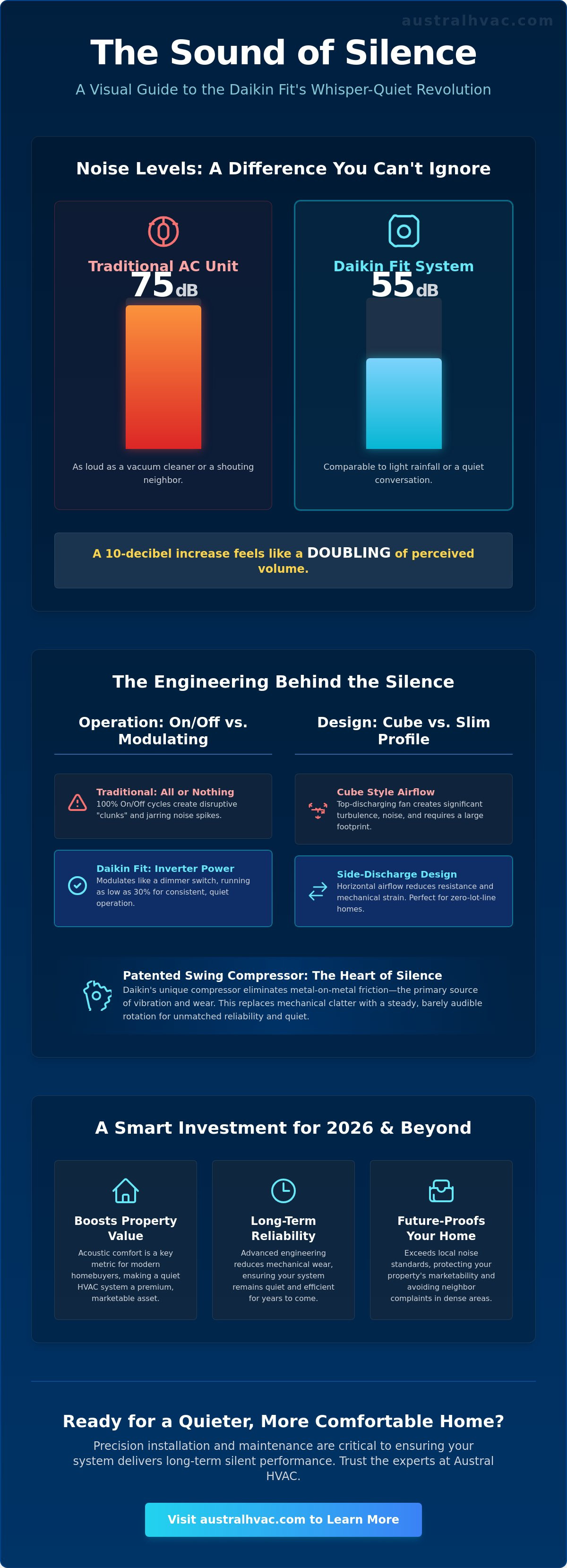
Did you know that a mere 10-decibel increase in sound feels like a doubling of volume to the human ear? For many homeowners, the jarring clunk of a traditional AC kicking on isn't just a nuisance; it's a disruption that vibrates through walls and irritates neighbors. As we move through 2026, the Daikin Fit noise level has become a benchmark for peaceful living, operating at a whisper-quiet 55 to 60 decibels. This is significantly lower than the 75-decibel roar of older systems, providing a level of comfort that matches the modern demand for quieter, more efficient home environments.
We understand that your home should be a sanctuary, not a construction zone. You likely want an HVAC system that works hard without announcing its presence every few minutes. In this guide, we'll break down the advanced inverter engineering that allows the Daikin Fit to maintain such low sound profiles. You'll discover how its specialized quiet mode can drop output to 45 decibels and see how this technology compares to traditional units in real-world performance. From technical specs to the long-term reliability that offsets current market shifts, we'll show you why this investment is a smart move for a quieter 2026.
Key Takeaways
Understand how a 55 dB operating volume compares to light rainfall, helping you visualize the immediate impact on your home's acoustic environment.
Examine the inverter swing compressor technology that regulates the Daikin Fit noise level, ensuring you don't have to deal with disruptive startup vibrations.
Explore how the slim side-discharge design facilitates better airflow and reduces noise, making it a perfect fit for zero-lot-line homes in dense neighborhoods.
Gain confidence in your investment by learning how precision maintenance prevents mechanical wear from turning a quiet system into a noisy one.
Table of Contents
How Quiet is the Daikin Fit? Understanding Decibel Ratings
When you step into your backyard, you shouldn't feel like you've walked onto an airport tarmac. Sound measurement is often misunderstood because decibel ratings follow a logarithmic scale rather than a linear one. The Daikin Fit noise level typically sits at a remarkably low 55 dB, which is a stark contrast to the 72 to 78 dB range produced by standard cube style units. This difference isn't just a slight improvement; it's a fundamental change in how you experience your outdoor space and your home's interior peace.
The 55 dB Benchmark: What Does it Actually Sound Like?
Imagine the gentle hum of a high-end refrigerator or the sound of a light rainfall against a window. That's the 55 dB experience. Because of the logarithmic nature of sound, a 20 dB reduction means the system is perceived as significantly quieter than a traditional unit. While older compressors announce their presence with a loud mechanical groan, the Fit operates with a consistent, low-frequency purr. It's the difference between a shouting neighbor and a quiet conversation in a library.
Why Noise Reduction is a 2026 Economic Asset
Noise isn't just a comfort issue — it's increasingly a compliance and property-value issue. More Austin municipalities and HOAs have adopted stricter outdoor equipment noise rules in recent years, and a system that runs quiet gives you more flexibility on where you can place the outdoor unit without triggering a variance or a neighbor complaint. For multi-family properties, a quieter system also means fewer tenant complaints tied to the equipment itself, which translates directly into less time spent on service calls that have nothing to do with an actual malfunction.
The Engineering Behind the Silence: Inverter Tech vs. Traditional Units
Traditional air conditioners operate like a light switch; they're either 100% on or completely off. This binary operation creates the aggressive "clunk" that often wakes you up at night. The Daikin Fit noise level is kept exceptionally low through inverter technology, which acts more like a dimmer switch. By modulating power, the system can run at as low as 30% capacity. This prevents the surge of noise associated with full-power cycles. Understanding Decibel (dBA) Ratings helps us see that consistent, lower-frequency sounds are far less disruptive to the human ear than sudden spikes in volume.
Side-Discharge vs. Traditional Cube Style
Most standard AC units use a "cube" design that pulls air through the sides and blasts it out the top. This creates significant fan turbulence and requires a large footprint. The Daikin Fit utilizes a slim, side-discharge design. Because air moves horizontally across the heat exchanger, there's less wind resistance and mechanical strain. The Daikin Fit noise level stays consistent because the side-discharge fan doesn't have to work against gravity like a top-venting unit. This compact profile is especially beneficial for Daikin Fit installation in Austin, where tight side yards and zero-lot-line properties often turn traditional units into echo chambers against neighboring walls.
The Role of Daikin’s Patented Swing Compressor
At the core of this system is the Inverter Swing Compressor. In a standard compressor, the internal piston often makes contact or creates friction during its cycle, leading to vibration. If you were to look at a technical diagram of the swing compressor, you'd see a single, integrated component that rotates smoothly without the "lifting" motion found in traditional scroll designs. This design prevents the "slapping" sound of moving parts, replacing mechanical clatter with a steady, barely audible rotation.
We define the Swing Compressor as the heart of Daikin’s silent reliability because it eliminates metal-on-metal friction. This engineering choice not only reduces noise but also prevents refrigerant leaks, ensuring your system stays quiet for years. If you're looking to upgrade your home's comfort, you can explore our high-performance Daikin systems to find the right fit for your space. Precision engineering ensures that your investment provides both peace of mind and a peaceful backyard.
Real-World Performance in Austin Neighborhoods
Austin's urban landscape is shifting toward higher density, with zero-lot-line homes becoming the standard in many new developments. When your neighbor's bedroom window is only ten feet from your outdoor unit, a traditional AC’s 75-decibel roar becomes a source of social friction. The Daikin Fit noise level provides a "good neighbor" solution by staying whisper-quiet, even during the brutal 100-degree days of a Central Texas August. By choosing a system that operates at a lower volume, you protect yourself from potential city noise ordinance disputes and maintain the peaceful atmosphere of your community.
Many homeowners worry that high-performance cooling requires a loud, aggressive machine. However, the U.S. Department of Energy highlights The Engineering Behind the Silence by explaining how variable-speed controls allow systems to meet cooling demands without the constant high-volume cycling of older technology. This precision is vital for Austin residents who want to balance elite cooling power with fiscal responsibility as local energy rates fluctuate.
Placement Strategies for Maximum Sound Dampening
The machine's design is only half the battle; where it sits matters just as much. We prioritize mounting these units on vibration-isolating pads or specialized wall brackets that prevent mechanical hums from traveling through your home's framing. A professional site assessment is essential to avoid "echo chambers" created by narrow side yards. Proper positioning ensures the Daikin Fit noise level remains a background hum rather than a focal point of your backyard.
Sound Quality vs. Sound Level
There's a significant difference between the volume of a sound and its intrusiveness. Traditional cube-style units produce a low-frequency drone that easily penetrates walls and windows. The Fit produces a higher-frequency, smoother sound that dissipates quickly into the open air. This shift in sound quality means you can actually enjoy your patio or deck while the system is running. If you're tired of shouting over your old air conditioner, contact our team for a quiet-system evaluation to reclaim your outdoor living space.
Ensuring Long-Term Quiet: Installation and Maintenance
Achieving the lowest possible Daikin Fit noise level isn't just about the machine; it's about the hands that install it. We often see "Solar Cowboys" or cut-rate installers rush through the setup, leaving homeowners with systems that don't live up to their silent promises. A high-efficiency unit is a precision instrument. If the indoor coil isn't perfectly matched or the ductwork is undersized, you'll hear a distracting whistling sound or high static noise. This air turbulence negates the engineering benefits of the inverter system. Understanding the Daikin Fit system cost involves looking at the total return on investment, which only remains high when the installation is handled with technical discipline.
Correcting the "Inverter Whine" Myth
You might find threads on Reddit discussing a high-pitched sound from new units. This is almost always a result of poor installation rather than a flaw in the Daikin Fit noise level specs. If an installer doesn't calibrate the refrigerant charge correctly, the system experiences unnecessary strain. We treat every installation as a mission to restore comfort, using granular technical expertise to eliminate these avoidable noises. Our team prioritizes punctuality and a steady, methodical startup phase to ensure every mechanical adjustment is perfect before we leave your home.
Preventative Maintenance for Silent Operation
Even a whisper-quiet unit can become noisy if dirt and debris accumulate on the side-discharge fan. An unbalanced fan blade creates a wobble that vibrates through your mounting brackets. Our Preventative Maintenance Agreements act as a "Peace of Mind" insurance policy for your home's acoustics. We focus on restoration and precision, ensuring your fan blades are clean and your electrical connections are tight. This proactive care keeps your home environment peaceful and protects your financial respect for the equipment. By catching minor mechanical imbalances early, we ensure your system remains a silent partner in your home's well-being for years to come.
Invest in a Quieter and More Efficient Home Future
Choosing the right HVAC system is a decision that impacts your daily comfort and your long-term financial health. We've seen how the 55 dB Daikin Fit noise level sets a new standard for residential acoustics, allowing you to enjoy your outdoor living spaces without the constant drone of traditional machinery. This whisper-quiet performance depends on the technical discipline of your installer and a commitment to ongoing maintenance that prevents mechanical wear. As Austin-local expert installation professionals, we ensure that your system is commissioned with the precision required to maintain its silent operation through 2026 and beyond.
As an Authorized Daikin Representative specialized in high-efficiency inverter systems, we prioritize restoration and integrity over simple sales. Our goal is to provide reliable solutions that stand up to the Texas heat while respecting your budget in an evolving economic landscape. Don't let a loud, outdated unit disrupt your peace of mind or your relationship with your neighbors any longer.
Your journey toward a more peaceful and efficient home starts with a single conversation. We look forward to being your high-performance partner in home comfort.
Frequently Asked Questions
Is the Daikin Fit the quietest air conditioner on the market?
The Daikin Fit is widely considered one of the quietest side-discharge systems currently available in the 2026 market. While some premium ductless units offer similar levels, the Fit stands out for whole-home cooling with an operational "quiet mode" that can drop as low as 45 dBA. This level is comparable to a quiet library. It provides a significant advantage for homeowners who prioritize a peaceful indoor and outdoor environment without sacrificing cooling power.
How many decibels is a Daikin Fit compared to a standard AC?
A standard air conditioner typically operates between 72 and 78 decibels, while the Daikin Fit noise level stays between 55 and 60 decibels. Because sound is measured on a logarithmic scale, this 20-decibel difference means a standard unit sounds about four times louder than the Daikin system. While a traditional unit might sound like a loud vacuum cleaner, the Fit is closer to the volume of a quiet office or background conversation.
Why is my Daikin Fit making a high-pitched noise?
A high-pitched noise on an otherwise quiet system is usually a sign of something specific rather than general wear — most often a refrigerant flow restriction, a failing fan motor bearing, or debris caught in the outdoor fan blade. Because the Fit's baseline operating sound is so low, these issues tend to stand out much earlier than they would on a louder traditional system, which is actually an advantage: you'll typically notice a developing problem well before it becomes a failure. If the sound persists after clearing visible debris, it's worth having a technician check refrigerant charge and fan motor condition before it escalates.
Can I install a Daikin Fit near a bedroom window without being disturbed?
You can absolutely install this system near a bedroom window because its side-discharge design directs air away from the house rather than up and out. Traditional units often rattle windows during their startup cycle, but the Fit’s soft-start inverter eliminates that jarring "clunk." When paired with professional vibration-isolating mounting, the system remains barely audible from inside, ensuring your sleep remains undisturbed even on the most humid Texas nights.
Does the Daikin Fit get louder when it is very hot outside?
The system may increase its fan speed during extreme 100°F+ heat, but it still maintains a lower sound profile than a standard unit. Traditional air conditioners must run at 100% capacity and cycle on and off frequently in the heat, creating loud surges. The Daikin Fit uses its variable-speed compressor to modulate smoothly. It works harder when necessary without the aggressive mechanical thrashing common in older, single-stage cooling technology.


Comments