

Cost to Install a Mini Split in Austin: 2026 Guide

Updated: 7 days ago
That "budget-friendly" quote for your home cooling might actually be the most expensive mistake you make this year. You are likely tired of seeing your utility bills climb every Austin summer, and the maze of conflicting quotes for new equipment only adds to the stress. It's frustrating when you just want a comfortable home without worrying if your electrical panel can even handle the upgrade. We understand that fiscal responsibility is just as important as physical comfort. This guide provides a clear, honest breakdown of the cost to install mini split Austin homeowners can expect in 2026, including how federal tax credits and high-efficiency equipment choices can keep your investment manageable.
We'll explore the impact of the national refrigerant transition, the long-term savings that reward high-efficiency choices, and how a professional installation protects your warranty. By focusing on the latest economic data and policy shifts, like the 30% federal tax credit under Section 25C and the R-410A phase-down, you can make an informed decision that enhances your home value by up to 7%. Our goal is to provide the technical expertise you need to secure a high-performance system that reduces resource consumption while respecting your financial goals.
Key Takeaways
Learn how 2026 SEER2 efficiency standards and new lower-GWP refrigerant mandates are reshaping market pricing for modern ductless systems.
Discover how the $2,000 federal heat pump tax credit can significantly lower your total cost to install mini split Austin equipment.
Identify the critical electrical requirements and thermal load calculations that determine if your existing panel can support a high-efficiency VRF or multi-zone system.
Protect your financial investment by understanding why premium manufacturers like Daikin and Amana require certified professional installation to maintain valid equipment warranties.
Understand our "restoration over replacement" philosophy, which ensures you only invest in new hardware when maintenance no longer provides a reliable path to efficiency.
Table of Contents
Average Cost to Install a Mini Split in Austin (2026)
The 2026 market for high-performance cooling is shifting due to new federal regulations and updated efficiency benchmarks. When evaluating the cost to install mini split Austin residents must consider more than just the price of the outdoor condenser. Current market trends reflect the transition to lower-GWP refrigerants like R-454B and R-32, which are now required for new equipment manufactured after January 1, 2025. These environmental standards ensure your system is future-proofed, though they require specialized handling by certified technicians. At Austral, we lead with a "Repair-First" philosophy. We believe in maximizing the life of your current equipment through meticulous maintenance. We only recommend a new installation when the energy savings and reliability of a modern system provide a superior financial return for your household.
There's a significant gap between "equipment-only" prices found on wholesale websites and a full-service professional installation. A proper setup involves complex electrical work, precision refrigerant charging, and structural mounting that protects your home's integrity. Understanding how mini-split systems work helps clarify why these technical steps are vital. A professional installation ensures your Daikin or Amana warranty remains valid, providing long-term mental ease that a DIY approach cannot match.
Single-Zone vs. Multi-Zone Price Breakdown
The scope of your project is the primary driver of the final quote. A single-zone system is the standard choice for targeted cooling in a garage apartment, a primary bedroom, or a sunroom conversion. These "one-to-one" setups are straightforward and offer immediate relief from Austin’s extreme thermal loads. If you need to cool multiple rooms, a multi-zone system uses one outdoor condenser to power several indoor "heads." Adding indoor units increases the complexity of the refrigerant line routing and the total investment. You can choose from various styles to match your interior design:
Wall-Mounted Units: The most common and cost-effective option for high-airflow distribution.
Floor-Mounted Units: Ideal for attic conversions with low knee walls or rooms where wall space is limited.
Ceiling Cassettes: A premium, recessed option that provides 360-degree airflow and a flush, minimalist look.
Labor and Permitting in Central Texas
Austin’s labor market for specialized HVAC technicians remains competitive, reflecting the high level of expertise required for modern VRF and ductless technology. Proper installation in Central Texas requires municipal permits to ensure the system meets local building codes and safety standards. These permits involve official inspections that verify the electrical safety and structural mounting of your unit. A non-negotiable part of our service is the professional vacuuming of refrigerant lines. This process removes all moisture and non-condensables from the system, which prevents internal corrosion and ensures your mini-split achieves its rated SEER2 efficiency. Skipping this step is a common DIY error that leads to premature compressor failure and high energy consumption.
Key Factors That Drive Your Austin Installation Quote
Calculating the total cost to install mini split Austin homeowners face requires an analytical look at your property’s specific thermal profile. While a generic online calculator might give you a baseline, the reality of Central Texas heat demands a more granular approach. We focus on matching the mechanical capability of the system to the unique architecture of your home to ensure long-term reliability and mental ease.
A unit's BTU rating must align perfectly with your room's square footage and insulation quality. If a system is undersized, it'll struggle to maintain comfort during a July heatwave, leading to premature wear on the compressor. Conversely, an oversized unit will cool the room too quickly without removing humidity, leaving your space feeling damp and clammy. Precision sizing is the cornerstone of our service philosophy, protecting both your comfort and your wallet.
The physical distance between your indoor air handler and the outdoor condenser also impacts the final quote. Longer line sets require additional refrigerant and more labor for proper concealment and structural protection. If the vertical rise between units is significant, we may need to install specialized condensate pumps to ensure moisture is removed effectively from your living space.
SEER2 Ratings and the Texas Heat
In 2026, efficiency isn't just a buzzword; it's a financial strategy. Higher SEER2 ratings are designed specifically for climates like ours where temperatures regularly exceed 100 degrees. Inverter technology, a hallmark of the Daikin Fit systems we install, allows the compressor to modulate its speed rather than just turning on and off. This prevents the short-cycling that plagues older systems, leading to lower utility bills. These high-efficiency models often qualify for Federal tax credits of up to $2,000, which significantly offsets the initial equipment price.
Electrical and Structural Modifications
Older Austin bungalows often lack the electrical infrastructure for modern cooling upgrades. You might need a dedicated 220V circuit installed from your main panel to the outdoor unit to meet safety codes. We also evaluate whether a ground-level concrete pad or a heavy-duty wall bracket is better for your outdoor condenser. If you aren't sure where to start, a professional system assessment can clarify these structural needs before you commit to a quote.
Maximizing ROI: Federal Credits and Efficiency
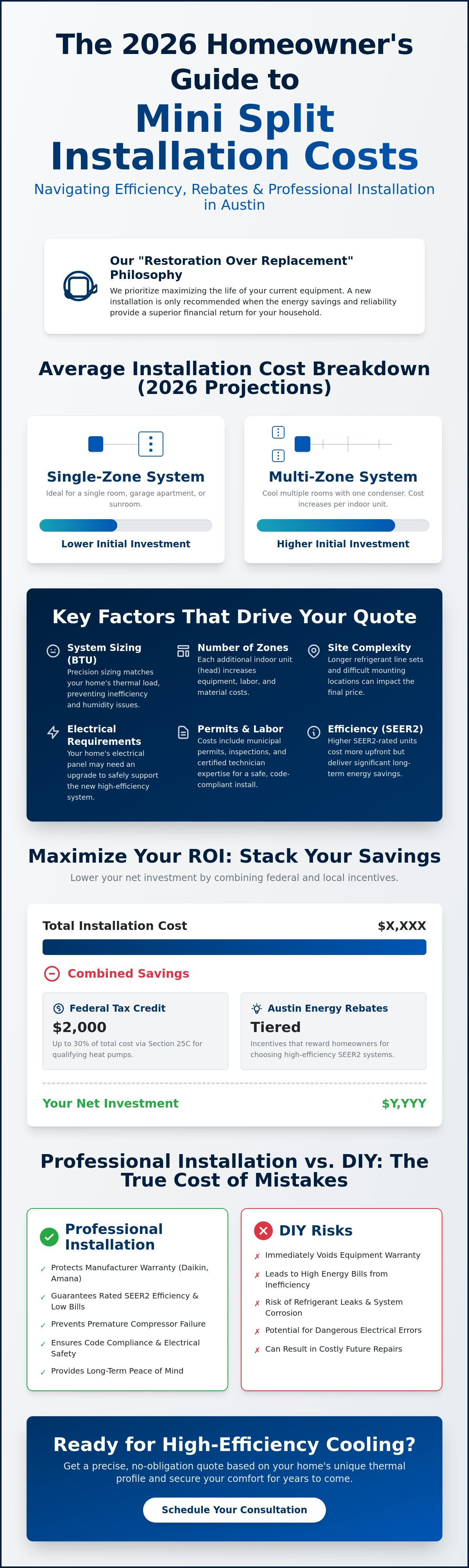
The primary driver of immediate savings is the Federal Energy Efficient Home Improvement Credit (Section 25C). For 2026, this provides a tax credit of 30% of your total installation cost. If you choose a qualifying high-efficiency mini-split heat pump, you can claim a credit of up to $2,000 per year. For standard air conditioning models, the credit is capped at $600. These federal incentives are designed to encourage the adoption of all-electric cooling, which reduces your environmental footprint while protecting your wallet.
Long-Term Energy Savings in Central Texas
Replacing inefficient window units or aging central air with a ductless system can lead to a significant reduction in monthly utility consumption. In the competitive Austin real estate market, these upgrades are highly valued; research from sources like Angi suggests that a high-efficiency mini-split can increase home value by 5% to 7%. Energy Optimization in Central Texas is the strategic use of inverter technology to manage both temperature and the intense humidity that characterizes our local climate. This balanced approach ensures your system doesn't just cool the air but enhances the overall health and quality of your indoor environment.
Professional Installation vs. DIY: The True Cost of Mistakes
The temptation to reduce the upfront cost to install mini split Austin systems by attempting a DIY project is high, but the legal and financial risks are often insurmountable. Under the federal AIM Act, handling modern refrigerants requires EPA Section 608 certification. Improper handling doesn't just risk heavy fines; it endangers the environment and your family's safety. Most premium manufacturers, including Daikin and Amana, strictly mandate that a licensed professional performs the installation. If you install it yourself, you effectively void the equipment warranty on day one, leaving you financially vulnerable if a major component fails.
Professional installation provides a level of mechanical precision that standard household tools can't match. We've seen many homeowners struggle with leaking flares or improper drainage that eventually damages their walls and flooring. These errors often stem from a lack of specialized equipment. Our team uses calibrated micron gauges to ensure the system is completely dehydrated and torque wrenches to create airtight seals. This technical diligence protects your system's longevity and ensures it operates at its peak rated efficiency.
Warranty Protection and Reliability
A professional guarantee offers mental ease that no YouTube tutorial can provide. While a DIY install leaves you alone when things go wrong, our service includes extended labor warranties that supplement the manufacturer's parts coverage. We prioritize doing it right the first time to prevent the stress of a system failure during a triple-digit heatwave. This commitment to technical excellence is how we build lasting relationships within the Austin community.
The Hidden Costs of 'Cheap' Labor
Choosing "cheap" labor often leads to expensive emergency repairs. In our local climate, even a small error in line set insulation or unit leveling leads to significant mold growth and unmanaged humidity. These issues quickly erase any initial savings and can compromise your home's air quality. Trust and timing are essential when choosing a partner for your home's cooling. If you want to avoid these pitfalls and protect your investment, schedule a professional installation quote today to secure your home's comfort.
The Austral Advantage: High-Efficiency Cooling Done Right
Our commitment to your home begins with an ethical promise: we prioritize restoration over replacement. While many contractors push for new equipment at the first sign of trouble, our "Repair-First" philosophy ensures we only recommend a full installation when it's the most fiscally responsible path for you. We understand that the cost to install mini split Austin systems is a significant investment. We treat that investment with the same respect we'd show our own neighbors, balancing elite technical service with genuine community care.
Specializing in Daikin Fit and VRF (Variable Refrigerant Flow) technology allows us to provide cooling solutions that are perfectly tuned to the Central Texas climate. These systems offer superior humidity control and energy efficiency, which are essential for maintaining a healthy indoor environment during our relentless summers. To protect your new system, we offer comprehensive preventative maintenance agreements. These plans are designed to enhance system longevity, ensuring your high-performance cooling continues to operate at peak efficiency for years to come.
Authorized Daikin and Goodman Expertise
As authorized representatives for premium manufacturers like Daikin, Goodman, and Amana, we provide our clients with exclusive access to the latest high-efficiency models and genuine factory parts. Our technicians undergo rigorous, ongoing education to master complex inverter systems and modern refrigerant handling. This specialized training translates into a more reliable installation for your home. We believe in personal accountability; our leadership stands behind every project, ensuring that the technical precision of our work matches the integrity of our word.
Ready for a Quote?
We've streamlined our pricing process to be as transparent and stress-free as possible. There are no hidden fees or surprise "add-ons" once we provide your estimate. We respect your time and schedule our local Austin assessments to fit your busy life. If you're ready to lower your utility bills and enhance your home's comfort, Schedule your Austin mini-split consultation today. Let us help you secure a high-efficiency future for your home with a partner you can trust.
Secure Your Home’s Efficiency and Financial Future
Navigating the 2026 HVAC landscape requires a partner who understands the intersection of high-performance technology and economic responsibility. By leveraging incentives like the $2,000 federal tax credit, you can significantly mitigate the initial cost to install mini split Austin equipment while securing long-term utility savings. Choosing a system with the latest low-GWP refrigerants isn't just a regulatory requirement; it's a strategic move to future-proof your home's air quality and overall market value.
Our team bridges the gap between elite technical service and neighborly care. As an Authorized Daikin Fit Pro Installer with local Austin expertise since 2024, we remain committed to our repair-first ethics. This means we prioritize restoring your existing system whenever possible, protecting your financial interests. When you're ready to move forward, we provide a transparent path to a more comfortable living space.
We're here to help you achieve a cooler, more efficient home that respects your budget and your family's comfort. Let's work together to make this summer your most comfortable one yet.
Frequently Asked Questions
How much does a single-zone mini-split cost in Austin?
The total cost to install mini split Austin projects depends on factors like the unit's BTU capacity and the complexity of the electrical run. A single-zone system is generally the most cost-effective way to add high-performance cooling to a specific room, such as a home office or master bedroom. We focus on providing a clear, honest breakdown that reflects the technical requirements of your specific space and ensures your warranty remains protected.
Can a mini-split really cool my Austin garage in the summer?
Modern ductless systems are exceptionally effective at cooling Austin garages, even during 100-degree summers. Because garages often lack insulation, we recommend a unit with a slightly higher BTU capacity to manage the extreme thermal load. This specialized cooling turns a stifling storage space into a comfortable workshop or gym. It's a reliable way to enhance your home's usable square footage without the need for expensive ductwork.
How long does a professional mini-split installation take?
Most professional mini-split installations are completed within four to eight hours. A single-zone setup is often finished in half a day; multi-zone systems may require a full day or more depending on the complexity of the line set routing. This timeline includes the precise vacuuming of refrigerant lines and the final safety inspections required for local compliance. Our goal is to restore your comfort with minimal disruption to your daily routine.
Is a mini-split more efficient than a central AC system?
Mini-splits are generally more efficient than central AC systems because they eliminate the energy loss associated with ductwork. Research indicates that duct loss can account for more than 30% of energy consumption in a typical home. By providing targeted cooling only where it's needed, these systems significantly reduce your monthly utility bills. They also allow for independent temperature control in different rooms, which enhances overall system efficiency.
What size mini-split do I need for a 400-square-foot room in Texas?
For a 400-square-foot room in the Texas heat, you typically need a 12,000 BTU unit. Factors like ceiling height, window placement, and sun exposure can increase this requirement. We perform a detailed load calculation to ensure your system provides reliable comfort without short-cycling. This technical precision protects your equipment from premature wear and ensures your indoor environment remains healthy and dehumidified.
Do I need to upgrade my electrical panel for a mini-split?
You may need an electrical panel upgrade if your current system is at capacity or if you live in an older Austin home. Mini-splits require a dedicated 220V circuit to the outdoor condenser. We evaluate your existing panel during our assessment to ensure your home can safely support the cost to install mini split Austin homeowners expect for a modern upgrade. This protects your property and ensures the system operates reliably.
What is the difference between a mini-split and a VRF system?
A standard mini-split is a type of VRF (Variable Refrigerant Flow) system, but "VRF" usually refers to larger, more complex residential or commercial setups. While both use inverter technology to modulate compressor speed, VRF systems can handle many more indoor units and offer advanced heat recovery options. Both prioritize high-performance efficiency and personal comfort through precise mechanical adjustments. We help you choose the specific technology that best fits your home's architectural needs.


Comments