

Commercial HVAC Systems Explained Clearly
- Winder Moll
- May 17
- 6 min read

A restaurant dining room that never quite cools down at lunch, an office with one hot corner and one freezing conference room, a retail store with humidity problems near the entrance - these are the kinds of issues that make commercial hvac systems explained more than a technical topic. For business owners and facility managers, HVAC affects comfort, operating costs, equipment life, and whether the building works the way it should.
Commercial HVAC is not just a bigger version of what you have at home. It is built to serve larger spaces, longer operating hours, more occupants, and more demanding ventilation needs. That usually means more zones, more controls, more equipment types, and more pressure to keep everything running without disrupting business.
Commercial HVAC systems explained from the ground up
At its core, a commercial HVAC system handles three jobs: heating, cooling, and ventilation. In many buildings, it also plays a major role in humidity control, indoor air quality, and building pressure. That matters because a comfortable temperature alone does not guarantee a healthy or functional space.
A basic system moves air through equipment that heats or cools it, then distributes that air where it is needed. But in commercial settings, the setup can vary quite a bit. A small retail suite may use a rooftop packaged unit. A large office building may rely on chillers, boilers, air handlers, and a building automation system. A restaurant may need comfort cooling in the dining area, strong kitchen exhaust, makeup air, and refrigeration support all working together.
That is why there is no one-size-fits-all answer. The right setup depends on square footage, occupancy, building layout, hours of operation, code requirements, and how sensitive the space is to heat, humidity, or ventilation changes.
The main types of commercial HVAC systems
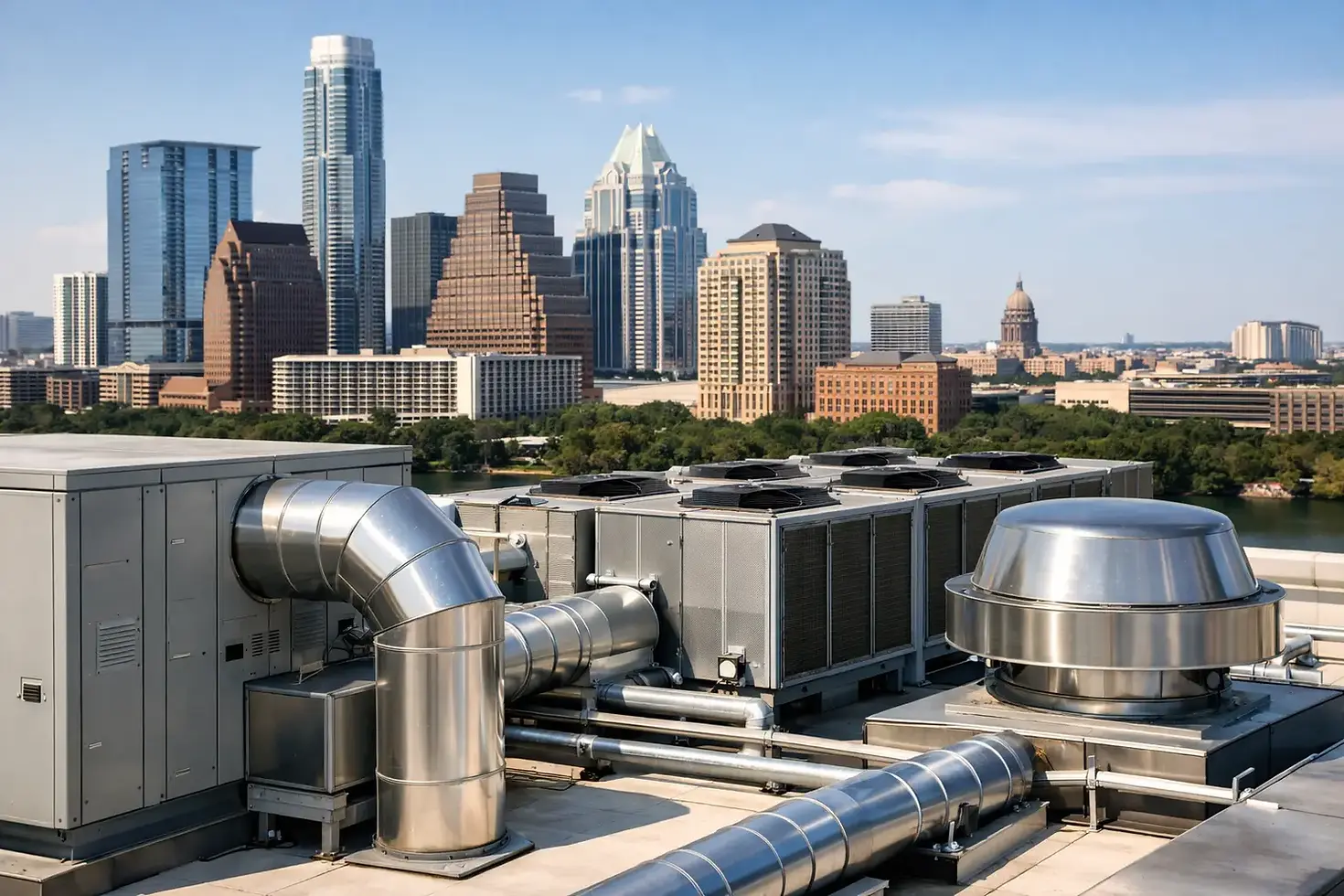
Packaged rooftop units are among the most common systems in light commercial buildings. These combine heating and cooling components in a single cabinet, usually installed on the roof. They are popular because they save indoor space, are relatively straightforward to service, and work well for offices, retail, and many mixed-use properties.
Split systems are another option. With this setup, part of the equipment sits outside and part stays inside. These can make sense for smaller buildings or spaces with specific layout constraints. They are familiar, flexible, and often cost-effective, but they may not offer the same scalability as more advanced commercial systems.
Variable refrigerant flow, or VRF, systems are designed for precise zoning and efficiency. They allow multiple indoor units to connect to one outdoor system, with the ability to condition different spaces independently. In buildings with varying occupancy or comfort needs, VRF can be a strong fit. The trade-off is that design, controls, and installation quality matter a great deal.
Chilled water systems are common in larger buildings. Instead of sending refrigerant throughout the building, these systems use chillers to cool water, then circulate that water to air handlers or fan coil units. They are efficient at scale and well suited for larger loads, but they require more infrastructure and a higher level of maintenance planning.
Boiler systems provide heating through hot water or steam. In some commercial properties, especially older or more complex facilities, boilers are still a practical and dependable solution. Like chillers, they are not casual equipment. They need proper piping, controls, combustion safety, and regular service.
The components that do the real work
When people talk about HVAC, they often focus on the main unit. In practice, system performance depends on the supporting components just as much.
Air handlers move conditioned air through the building. Ductwork carries that air to occupied spaces and brings return air back for reconditioning. If ducts leak, are undersized, or were poorly laid out, comfort problems can show up even when the main equipment is in decent shape.
Thermostats and control systems tell the equipment what to do. In many commercial buildings, those controls go beyond simple temperature settings. They may schedule run times, manage multiple zones, monitor performance, and help reduce energy waste during off-hours. Better controls can improve comfort, but only if they are set up properly.
Ventilation equipment brings in outside air and removes stale indoor air. In a commercial setting, this is a big deal. Occupancy levels, odors, indoor contaminants, and building codes all affect ventilation requirements. Too little outside air can hurt air quality. Too much, especially in hot and humid climates, can strain the system and raise utility costs.
Filters, dampers, economizers, pumps, exhaust fans, and sensors also play critical roles. A failed sensor or stuck damper can create complaints that look like equipment failure when the actual fix is smaller and less expensive.
Why zoning and ventilation matter so much
One of the biggest differences between residential and commercial systems is zoning. A commercial building rarely has uniform heating and cooling needs. Sun exposure, occupant density, equipment loads, and operating hours can vary from room to room.
A conference room packed for an afternoon meeting may need more cooling than a nearby storage area. A restaurant kitchen has very different ventilation needs than the dining area. A medical or technical space may need tighter pressure or filtration control than a standard office.
Good zoning allows each area to get what it needs without overconditioning the whole building. Done well, it improves comfort and efficiency. Done poorly, it creates constant complaints, short cycling, and rising energy bills.
Ventilation follows the same logic. Fresh air is necessary, but unmanaged ventilation can create major issues with humidity and load, especially in Texas. The goal is balance - enough outside air to support indoor air quality and code compliance, without forcing the cooling system to fight unnecessary heat and moisture all day.
Repair versus replacement is rarely a simple call
One of the most common questions from business owners is whether a struggling system should be repaired or replaced. The honest answer is that it depends.
If the equipment is structurally sound and the issue is isolated - a motor, control, contactor, sensor, or refrigerant leak that can be corrected properly - repair often makes sense. That is especially true when the cost is reasonable and the system still has useful life left.
Replacement becomes more likely when breakdowns are frequent, parts are obsolete, efficiency has dropped sharply, or the equipment was undersized from the start. In some buildings, repeated repairs are not really solving the problem because the underlying issue is poor design, failing ductwork, bad controls, or ventilation imbalance.
Budget matters too. The cheapest short-term option is not always the best long-term move, but not every business needs a full system overhaul today. A dependable contractor should be able to explain the condition of the equipment clearly, outline the trade-offs, and help you decide based on actual building needs rather than pressure.
What drives cost and performance
Commercial HVAC costs are shaped by more than equipment price. System type, building size, duct and piping requirements, controls, electrical capacity, crane access, roof conditions, and code compliance can all affect project cost.
Operating cost is another layer. A lower-priced system may cost more over time if it runs inefficiently, struggles with zoning, or requires frequent repairs. On the other hand, the most advanced system is not always the smartest buy if the building does not need that level of complexity.
Installation quality has a major impact here. Even a strong brand and efficient model can underperform if airflow is wrong, refrigerant charge is off, controls are poorly programmed, or ventilation was never balanced. That is why good design, commissioning, and follow-up service matter just as much as the equipment label.
Maintenance is where a lot of money is either saved or lost
Commercial systems work hard, and neglected equipment usually gives plenty of warning before it fails completely. Dirty coils reduce efficiency. Worn belts affect airflow. Clogged drains lead to water issues. Loose electrical connections create safety risks and nuisance shutdowns.
Routine maintenance helps catch these problems early. It also gives owners and facility teams a clearer picture of what the system needs over the next year or two. That is useful for budgeting, especially if you are managing multiple locations or older equipment.
For many businesses, the goal is not perfection. It is predictability. Planned service reduces emergency calls, protects product and occupant comfort, and helps avoid replacing equipment before it is truly necessary. Contractors like Austral HVAC Refrigeration Services often approach maintenance with that practical mindset - keep the system reliable, fix what can be fixed, and recommend replacement when the numbers actually support it.
How to know if your system needs a closer look
If utility bills keep climbing without a clear reason, comfort complaints are becoming routine, or certain areas never hold temperature, the system likely needs a professional evaluation. The same goes for short cycling, excess humidity, poor airflow, unusual noise, or repeated service calls for different parts of the same system.
Sometimes the equipment is failing. Sometimes the issue is in the controls, duct layout, ventilation, or deferred maintenance. Either way, a proper diagnosis matters. Guesswork gets expensive fast in commercial buildings.
The best commercial HVAC systems are not necessarily the biggest or newest. They are the ones that match the building, support the people inside it, and can be maintained without constant disruption. If your system is doing its job quietly, that is not luck. It is good design, good service, and attention to the details that keep a building running.


Comments